

33-02. IFR Navigation plan
All questions: 20
In mode TRAINING show all questions of the discipline with correct answers presentation. To go to the next question, click the “Next”.
Questions for exams: 20
In mode Exam correct answers are not shown, after choosing the answer, transition to the next question occurs automatically.
1. On an instrument approach chart, a minimum sector altitude (MSA) is defined in relation to a radio navigation facility. Without any particular specification on distance, this altitude is valid to:
2. (Refer to figure 033-33) Assume M 0,74/250 KIAS descent profile. How much time will elapse from top of descent (FL350) to level off at 5.000 feet?

3. (Refer to figure 033-14) Planning an IFR-flight from Paris (Charles de Gaulle) to London (Heathrow) for the twin jet aeroplane. Given: Estimated Take off Mass (TOM): 52.000 kg Airport elevation: 387 ft FL280 W/V: 280°/40 kts ISA Deviation: -10 °С Average True Course: 340° Find time to the top of climb (TOC).
.

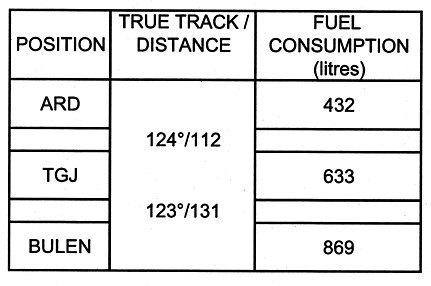
4. (Refer to figure 033-64) True Air speed: 170 kts Wind in the area: 270° / 40 kts According to the attached the navigation log, an aircraft performs a turn overhead BULEN to reroute to ARD via TGJ. The given wind conditions remaining constant. The fuel consumption during the turn is 20 litres. The total fuel consumption at position overhead ARD will be:
.
5. On IFR navigation chart, in a 1° quadrant of longitude and latitude, appears the following information: “80”. This means that within this quadrant:

