

32-02. PERFORMANCE CLASS B – SINGLE-ENGINE AEROPLANES
All questions: 51
In mode TRAINING show all questions of the discipline with correct answers presentation. To go to the next question, click the “Next”.
Questions for exams: 10
In mode Exam correct answers are not shown, after choosing the answer, transition to the next question occurs automatically.
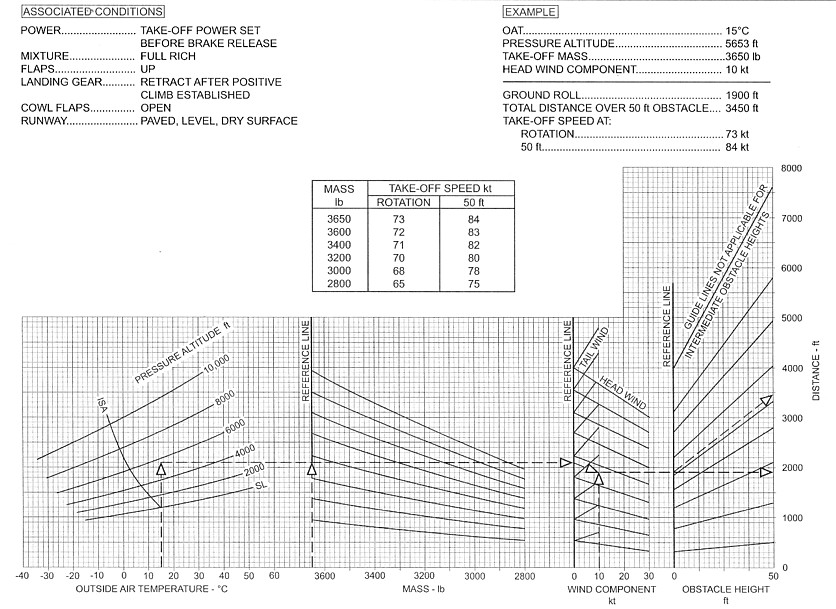
1. (Refer to figure 032-01)
With regard to the takeoff performance chart for the single engine aeroplane determine the takeoff distance to a height of 50 ft. Given:
OAT: 30 °C
Pressure Altitude: 1.000 ft, Aeroplane Mass: 3.450 lbs
Tailwind component: 2,5 kts, Flaps: up, Runway: Tarred and Dry
.
2. (Refer to figure 032-04)
With regard to the landing chart for the single engine aeroplane determine the landing distance from a height of 50 ft. Given:
OAT: 0″C
Pressure Altitude: 1.000 ft
Aeroplane Mass: 3.500 lbs
Tailwind component: 5 kts
Flaps: Landing position (down)
Runway: Tarred and Dry

3. If a TOD of 800 m is calculated at sea level, on a level, dry runway, with standard conditions and with no wind, what would the TOD be for the conditions listed below?
Airfield elevation: 2.000 ft
QNH: 1.013,25 mb, Temperature: 21 °C
Wind: 5 kts tailwind
Dry runway with a 2% up slope (Assuming: ±20 m per 1.000 ft elevation; +10 m per 1 kts of reported tailwind; ±5 m per 1°C ISA deviation and ±5% 11% slope)
4. (Refer to figure 032-02)
With regard to the takeoff performance chart for the single engine aeroplane determine the takeoff distance to a height of 50 ft. Given:
OAT: 38 °C
Pressure Altitude: 4.000 ft, Aeroplane Mass: 3.400 lbs
Tailwind component: 5 kts, Flaps: Approach setting
Runway: Dry Grass, Correction factor: 1,2
.

5. What affect has a tailwind on the maximum endurance speed?

