

33-03. FUEL PLANNING
All questions: 18
In mode TRAINING show all questions of the discipline with correct answers presentation. To go to the next question, click the “Next”.
Questions for exams: 15
In mode Exam correct answers are not shown, after choosing the answer, transition to the next question occurs automatically.
1. A turbine-engine aircraft burns fuel at 200 gallons per hour (GPH) with a Fuel Density of 0,8. What is the fuel flow if Fuel Density is 0,75?
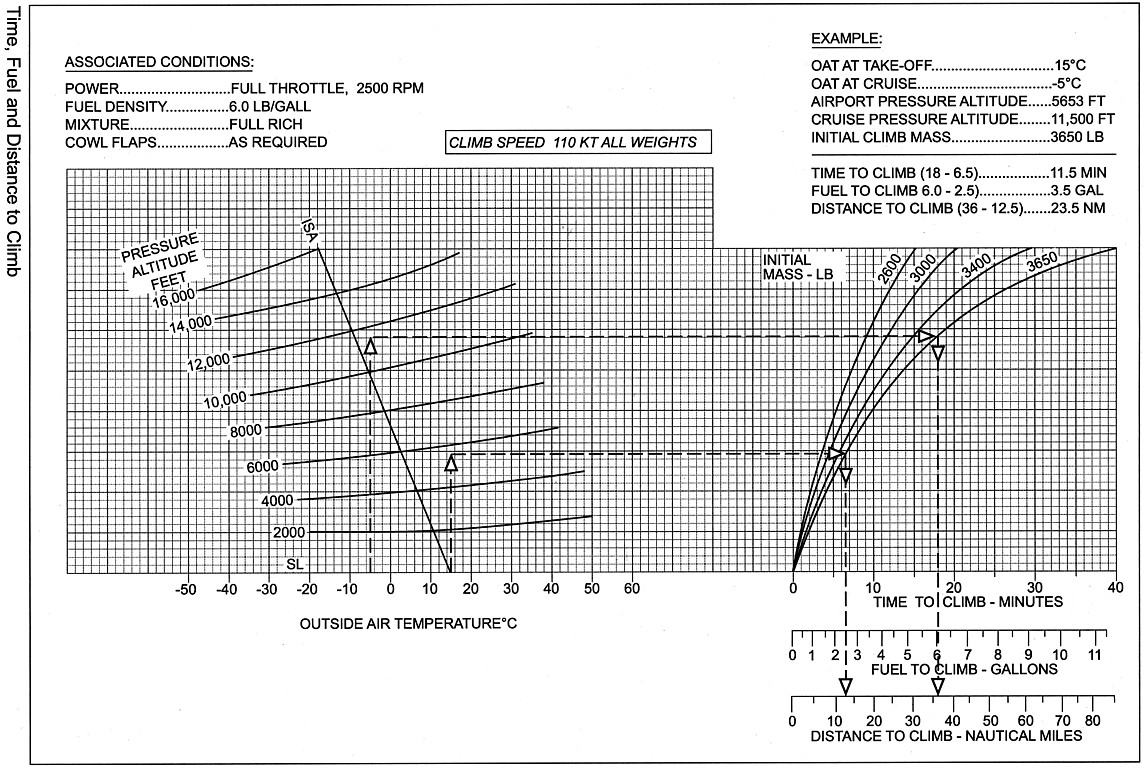
2. (Refer to figure 033-39) Given: FL75 OAT: +5 °С During climb: average headwind component 20 kts Takeoff from MSL with the initial mass of 3.650 lbs Find the still air distance (NAM) and ground distance (NM) using the graph TIME, FUEL, DISTANCE TO CLIMB:
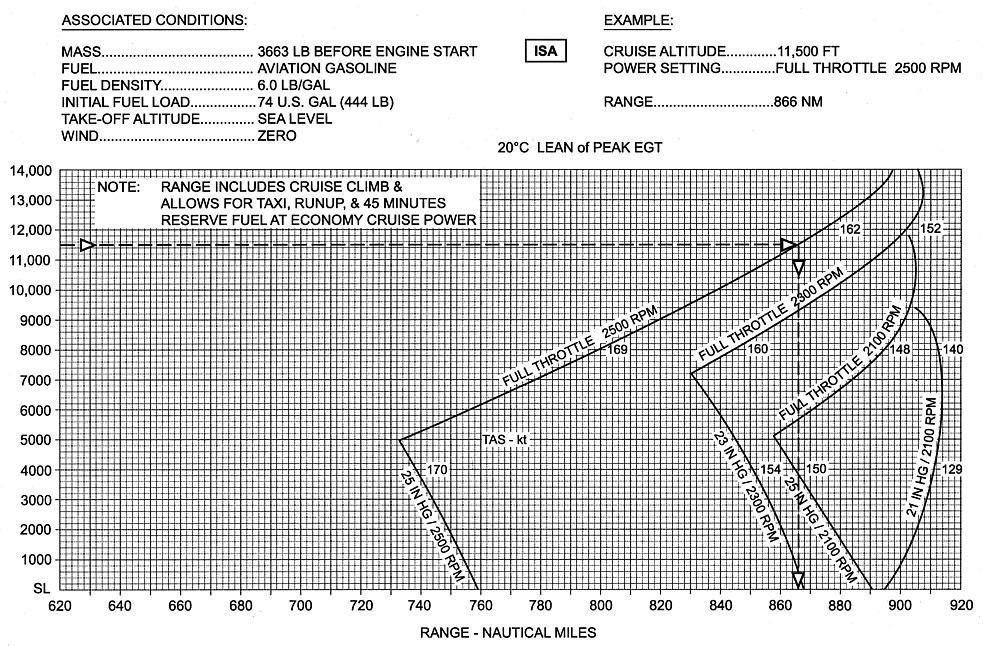
3. (Refer to figure 033-40) Using the following information, calculate the range. Given: Aeroplane mass at start up: 3.663 lbs Fuel load (density 6 lbs/gal): 74 gal Takeoff altitude: sea level Headwind: 40 kts Cruise altitude: 8.000 ft Power setting: full throttle 2.300 RPM 20 °С lean of peak
4. Given the following data determine the maximum possible takeoff fuel: Fuel density: 0,78 kg/l Dry Operating Mass: 33.500 kg Traffic Load: 10.600 kg Maximum Allowable Takeoff Mass: 66.200 kg Taxi Fuel: 200 kg Tank capacity:22.500 litres
5. (Refer to figure 033-41) For a flight departing from MSL at 3.663 lbs, cruising at FL80 at 2.300 RPM, 20 °С lean of peak EGT, in 40 kts headwind, calculate endurance:


